
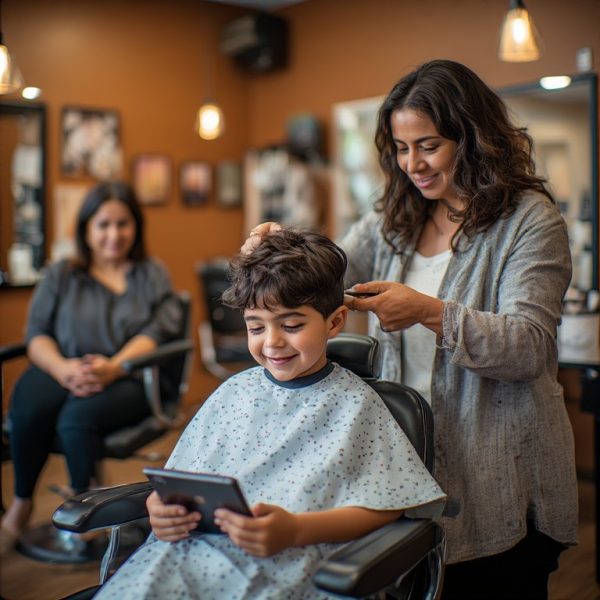
Haircuts for children with sensory processing disorder can feel overwhelming for both kids and parents, especially when everyday sensations trigger anxiety or discomfort. While some consider children’s haircuts nothing more than a simple grooming task, those navigating sensory challenges often face a very different experience.
Sensory processing disorder (SPD) affects how the brain interprets input such as sound, touch, movement, and smell. As a result, environments that seem ordinary to others may feel intense or even painful to a child with sensory sensitivities. Consequently, the bright lights, buzzing clippers, and falling hair involved in a typical salon visit can quickly become too much.
The Challenge of Haircuts and SPD
Sensory Processing Disorder Creates Unique Challenges for Getting a Haircut
To understand the difficulty, it helps to consider how sensory input works. Children with Sensory Processing Disorder may be hypersensitive, meaning they overreact to certain sensations. For example, the vibration of clippers might feel alarming, or loose hair on the neck may cause immediate distress. In other cases, children may be sensory-seeking and struggle to sit still long enough for a safe children’s haircut.
Additionally, salons are often busy, noisy places. Hair dryers hum, scissors snip, and conversations overlap. Therefore, what feels like normal background noise to one child may feel chaotic to another. Even strong smells from hair products can contribute to sensory overload.
Furthermore, children with SPD may have difficulty communicating exactly what feels wrong. As a result, frustration can escalate quickly into tears or resistance. Although the reaction may appear behavioral, it is actually rooted in how the nervous system processes information.
Preparation is Key
A little preparation can provide a lot of peace
Fortunately, thoughtful preparation can significantly improve the experience. First, parents can talk through each step of the haircut in advance. Explaining what tools will be used and what sensations might occur helps reduce unpredictability. Likewise, watching short videos of haircuts at home can build familiarity.
Another helpful strategy is role-playing. For instance, using pretend scissors on a doll or gently running fingers through the child’s hair can introduce the idea in a low-pressure way. Over time, gradual exposure helps the child feel more in control.
Equally important is choosing the right environment. Some salons, like Kazaams, now offer quieter appointment times or private rooms specifically designed for children with sensory needs. In these spaces, haircuts for children with sensory processing disorder are approached with flexibility, patience, and understanding. Kazaams provides a private, quiet space for those children with SPD to get their haircut without all of the typical salon environment stimuli.
Timing also plays a crucial role. Scheduling a children’s haircut when the child is well-rested and fed can prevent additional stress. In addition, bringing comfort items—such as noise-canceling headphones, a favorite toy, or a tablet—can provide distraction and reassurance.
Making Haircuts Routine
Creating a Positive and Predictable Routine
Consistency is especially valuable for children with SPD. When the same stylist, environment, and sequence of steps are repeated, the experience becomes more predictable. As a result, anxiety often decreases over time.
Moreover, stylists who specialize in haircuts for children with sensory processing disorder tend to move at the child’s pace. Instead of rushing, they may allow breaks, explain each action before touching the child’s head, and adjust techniques as needed. This collaborative approach builds trust.
Parents can also reinforce success through positive language. Praising small accomplishments—such as sitting still for a minute or tolerating the sound of clippers—encourages confidence. Eventually, these incremental wins lead to longer, smoother appointments.
Importantly, safety remains a top priority. Because sudden movements are common during sensory overload, experienced stylists maintain calm control and adapt quickly. In turn, parents can feel more secure knowing their child is in capable hands. Ms. Lita has decades of experience working with individuals with all types of sensory issues and offers a calming environment for this essential grooming task to be accomplished.
A Manageable Path Forward
Calmer and Positive Outcomes are On the Horizon
Although the first few attempts may feel discouraging, progress is possible. With preparation, patience, and supportive professionals, what once seemed impossible can become manageable. Over time, haircuts may shift from a source of dread to a predictable part of routine care.
Ultimately, haircuts for children with sensory processing disorder require understanding, flexibility, and compassion—but with the right approach, they can become a calmer and more positive experience for the entire family.